People Management
On-Demand Pay: How It Works & Benefits For Your Workplace

On-demand is changing the game for hourly workers and their employers, in ways that benefit both.
Because of the way paydays have always worked, many Americans live with constant financial stress and instability. Today, 37% of all adults would have difficulty paying for a $400 emergency expense.
This means in tight times, millions turn to payday lenders or other sources to make ends meet in between pay cycles. But it doesn’t have to be this way if hourly workers can access what they’ve already earned and have more flexibility around their cash flow.
Employees should be able to access their earnings for the work they do each day. That’s where on-demand pay benefits come in.
Plus, it can be a competitive advantage when attracting potential employees. So on-demand pay is a win-win for everyone.
Looking to learn more about on-demand pay or earned wage access? Keep reading or watch our YouTube video! You’ll see what on-demand pay is, how it works, why you should offer it, and how you can get started.
What is on-demand pay?
On-demand pay means employees have access to their money as they earn it. You may hear it called payroll on demand, wages on demand, daily pay, instant pay, or even earned wage access (EWA).
You can think about it in the same way you do gig economy pay. The worker gets paid as soon as the gig is finished, not for a paycheck 2 weeks later.
How does on-demand pay work?
Traditionally, you aren’t calculating payroll in real time. It’s something that’s tabulated over the cumulative pay period (which is what the pay periods are for). That makes the idea of on-demand pay seem like a huge change. How can employers pay any employee at any given moment what they’re owed?
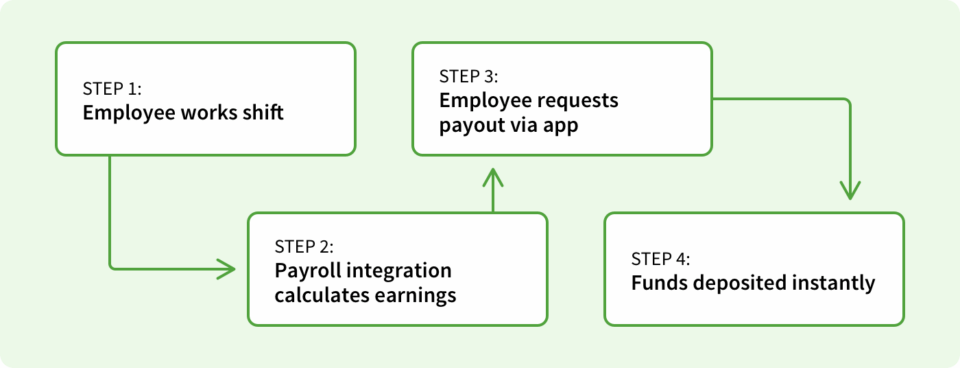
New business models are emerging to help employers solve this challenge, and today, on-demand pay is usually handled through a third-party or mobile app system, one that’s integrated into your payroll provider system.
A standard scenario might be an outside provider that’s integrated to your payroll system using cloud-based technology, calculates how much each employee earns on each shift, and makes that amount available to them should they want to request it.
It’s real-time access to real-time earnings, with pay frequency being whatever the employee needs.
On-demand pay benefits for employees
If you’re not sure if payroll on-demand is right for your workplace, consider the benefits not only to employees, but to managers, too.
Almost half of employees couldn’t handle a $400 emergency. That means they aren’t just living close to the line, they’re living on it. Having to wait for a future payday, and then waiting for their paycheck or bank deposit to clear the bank, means late payments and added fees for bills that are overdue.
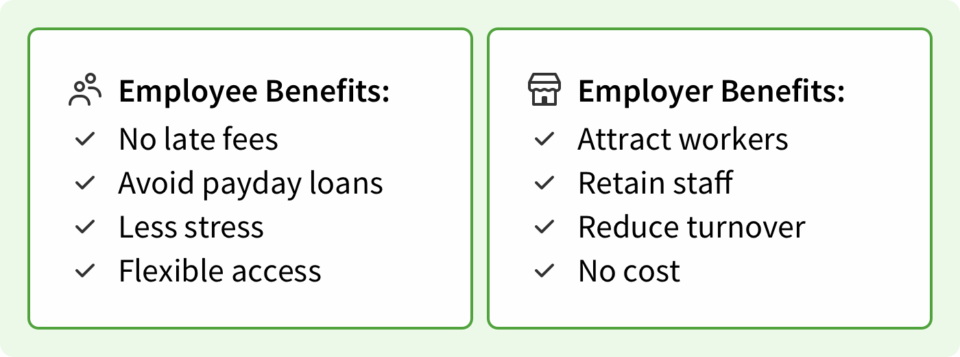
By giving your employees the ability to get to their money before payday means they don’t have to suffer from the financial stress of late fees, or turn to predatory payday loans or credit card debt to cover their needs. Emergencies are less stressful because they can access the money they’ve already earned whenever they need it.
Less stress means happier employees.
On-demand pay benefits for employers
Attract talent
In a tight labor market, employers need to find every last benefit they can in order to attract workers. Offering on-demand pay is part of telling potential employees that you care about their financial wellness.
A recent study revealed that 66% of workers want earlier access to the money they’ve earned to cover bills and emergency expenses. By offering access to their pay when they need it, you’re creating attractive financial wellness benefits for your employees—one your competitors aren’t offering—at no cost to your bottom line.
Reduce turnover
Just as benefits attract workers, good benefits that aren’t found elsewhere can help keep them. The difference between you and a competitor might simply be that employees get earned wage access.
And that can boost employee retention, too. You can save money with less employee turnover, and offering this benefit has been shown to reduce turnover by 40%.
On-demand pay vs traditional biweekly pay
This comparison table shows the differences between traditional pay periods and modern earned wage access.
| Traditional biweekly pay | On-demand pay | |
| Payment timing | Fixed and rigid | Real-time and dynamic |
| Employee flexibility | Low | High |
| Employer cost | Standard admin payroll processing costs | No net cost to add to current payroll process |
| Financial stress impact | Waiting until payday is a high contributor to stress | Helps alleviate financial stress |
| Retention impact | Neutral | Excellent, great competitive hiring advantage |
How to offer on-demand pay at your business
There are a few things to consider before taking the leap to on-demand pay benefits.
First, on-demand pay is all about giving your employees flexibility in their finances. Whether you have hourly or salaried workers, the service you provide should be able to accommodate both.
Then, you’ll want to choose a provider that works with your business. Look for one with a solid mobile component, where both managers and employees can manage work schedules, time clock, team communication, and wages on demand from their mobile device.
It’s also important to make sure you find an on-demand pay provider that’s free for your employees to use. Otherwise, you aren’t really helping them advance their financial wellness if they have to pay to access their wages sooner.
If you think it’s easier just to keep using a traditional payroll approach, imagine being one flu or flat tire away from missing a rent payment.
Without access to their money when they need it, your employees are placed in that precarious position every day. Giving them more control over their financial well-being helps them be happier and more productive at work.
On-demand pay FAQs
Q: Is on-demand pay the same as earned wage access?
A: Yes, they are the same, just different names. In addition to earned wage access, you might hear it referred to as EWA, daily pay, or instant pay.
Q: Is on-demand pay legal?
A: Yes. Major regulatory institutions, like a Consumer Financial Protection Bureau advisory opinion, have decided that employer-integrated on-demand pay is not credit and is fully legal.
Q: Does on-demand pay affect payroll taxes or compliance?
A: No. Because third-party providers calculate how much money an employee can access from verified employee earnings, employer standard payroll cycles remain the same. That means payroll taxes are the same, protecting compliance.
Q: Can salaried employees use on-demand pay?
A: Yes. A flexible on-demand pay platform can comfortably handle both hourly and salaried workers, based on the parameters you set with your provider.
Q: Does on-demand pay disrupt the regular payroll cycle?
A: No, the cloud-based system calculates mid-cycle advances based on verified earnings, so they’re automatically deducted from the employee’s payroll on the standard payday. There’s absolutely no change at all to your payroll cycle.