Payroll Resources
Payroll Software vs. Payroll Services: 5 Key Differences

Payroll software and payroll services both aim to help business owners run payroll. Payroll software vs payroll services both aim to run payroll, but the two boast stark differences regarding cost, control, and security. When manual payroll is not an option, comparing these two alternatives will help.
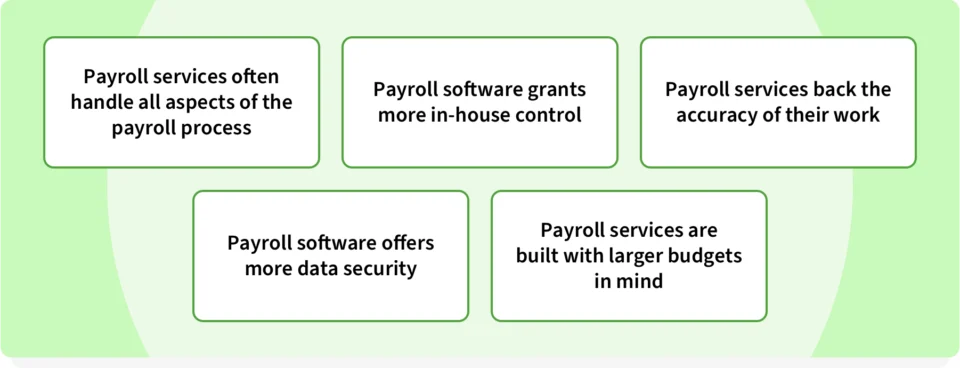
Here are five key characteristics to keep in mind about payroll software vs. payroll services:
- Payroll software is a tech-based solution that automates payroll processing.
- Payroll software does have a learning curve, so go with a well-supported solution.
- Payroll services are expensive and best suited for those with larger budgets.
- Payroll software can solve your compliance issues while saving time and money.
- Payroll services sometimes come with an accuracy guarantee. However, there may be a trade-off in terms of data access and security.
Table of contents
- Payroll software vs payroll service comparison table
- What is payroll software?
- Who uses payroll software?
- What are payroll services?
- Payroll software vs. payroll services: five differences
- Which is best for your business? Four considerations
- Elevate your payroll process with When I Work
- Payroll software vs payroll services FAQs
Payroll software vs. payroll service comparison table
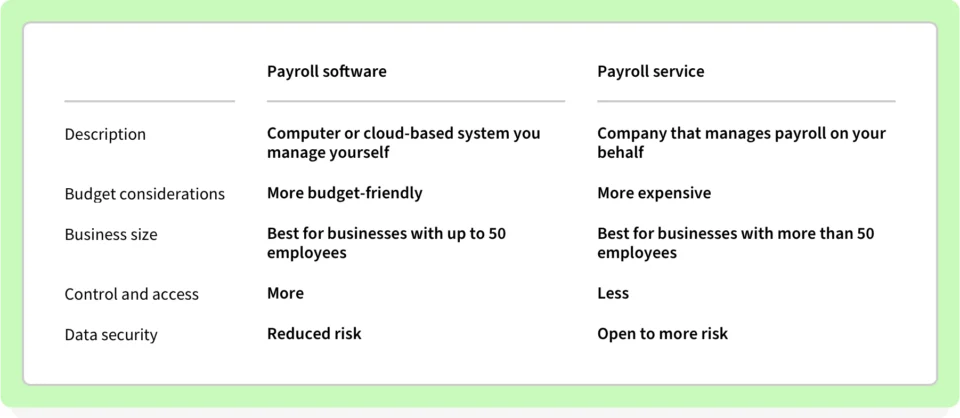
| Payroll software | Payroll service | |
| Description | Computer or cloud-based system you manage yourself | Company that manages payroll on your behalf |
| Budget considerations | More budget-friendly | More expensive |
| Business size | Best for businesses with up to 50 employees | Best for businesses with more than 50 employees |
| Control and access | More | Less |
| Data security | Reduced risk | Open to more risk |
| Check out the When I Work payroll integrations and see how much time you can save on processing. Start your free trial today! |
What is payroll software?
Payroll software is a computer-based solution for processing payroll. It can run entirely on your computer or online in the cloud. Payroll software runs on a secure system, and only certain employees can access it.
Payroll processing software usually includes many features that make payroll easier. These can include time tracking, messaging, and mobile apps for HR pros and employees.
Most software offers some level of payroll automation. These programs can easily automate wage and withholding calculations. Some can even run your payroll on schedule, while others can file taxes without you lifting a finger.
Who uses payroll software?
Many types of businesses find benefits to using payroll software. For instance, small businesses don’t always have money for an HR team and need to find a DIY payroll solution. Software helps them pay taxes correctly and on time. It also helps them manage payroll compliance and avoid legal issues that can devastate small businesses.
In addition, large businesses have so many employees that manual payroll would be too difficult. Payroll software makes paying hundreds of people much easier. It also makes keeping payroll records a breeze.
Other companies that use payroll software include healthcare, construction, and education businesses, which all pay employees at different wages and status levels. Payroll software makes it easy to pay different types of employees at once.
No matter the industry, though, payroll software makes processing quick and easy.
Add a payroll integration to save more time! Learn more about our available integrations and see how you can simplify scheduling and payroll for your team.
Advantages of payroll software
Using payroll software gives your company total control over the payroll process. You can make changes and decisions without having to contact anyone else. Plus, automated features make the process very efficient.
Disadvantages of payroll software
Someone must input data for new employees and make changes as needed. This requires time from a staff member. Also, most software has a learning curve. You might not know how to use it right away and you’ll need to devote time and resources to training.
What are payroll services?
Payroll services are businesses that take care of the whole process on your behalf. Some let you pick and choose the services you want. For example, you may want them to do your payroll but have your own accountant for taxes. Others just take over the process from start to finish. This would include onboarding employees, tracking time, disbursing the money, and filing taxes.
If you work with a professional employer organization (PEO), they become the co-employer of your workers. Your job is to operate the business. You’ve outsourced payroll, so the PEO takes over administrative tasks, especially those related to payroll.
Every firm offers something different. Because of this, you must do your research before you use a payroll vendor.
Payroll software vs. payroll services: five differences
Payroll software and payroll services both help you run accurate payroll, but they’re not the same. Here is a rundown of the major differences between the two solutions.
1. Payroll services often handle all aspects of the payroll process
Full-service payroll providers allow someone else to handle every part of the payroll process from start to finish. This often means that schedule and timesheet tracking, tax calculations and filing, and money disbursement are out of your hands.
Payroll software does automate the process. Still, it’s all handled by you or one of your own employees.
2. Payroll software grants more in-house control
With in-house payroll software, you have control over everything. You can customize payroll to run any way you want. You can also keep watch over your own data security to ensure it never falls into the wrong hands.
With payroll services, you must give up control to a third party. While you don’t have to take the time to run payroll, you also can’t determine what happens to your data.
3. Payroll services back the accuracy of their work
Many payroll services guarantee that their work will be accurate, taking full responsibility for any compliance issues that arise. Still, it’s important to know that you may ultimately be held responsible for mistakes.
Payroll software gives you the peace of mind of being able to check over payroll before it’s processed. Because it’s computerized, it’s also highly accurate and can help you maintain good legal standing.
4. Payroll software offers more data security
Payroll software is often run from the cloud. This makes it a very secure solution for those concerned about their data security.
Though most payroll services will offer some security, you don’t always know what their protocols look like. If a data breach occurs with a third party, you might still be liable.
5. Payroll services work best for larger budgets
Payroll services cost a lot. They’re not very cost-effective for businesses with a smaller budget. In comparison, payroll software usually costs much less. Best of all, it can scale with you as your business grows.
Which is best for your business? Four considerations
There are several things to think about before you decide which solution to use. Considering each of the following areas of your business will help you determine the right way to go:
1. Your budget
This will be what helps you see whether payroll services are an option for you. These services are very expensive. If you don’t have the money or don’t want to spend it, stick with payroll software.
When I Work preferred payroll partner
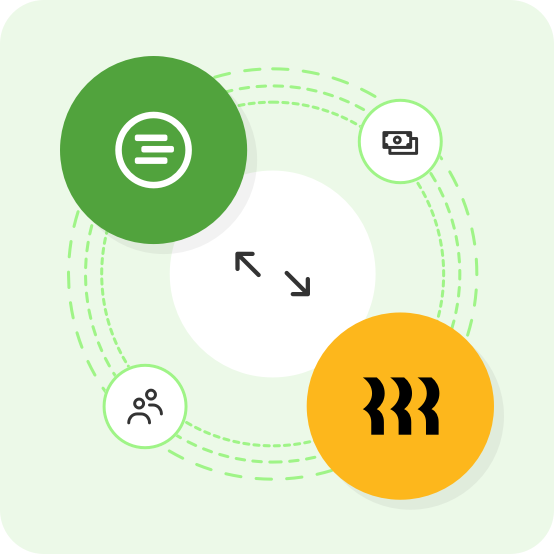
Make payroll simple with our preferred partner Rippling, an all-in-one platform for payroll, benefits, and compliance. Together, When I Work and Rippling help you save hours every week while reducing errors, staying compliant, and getting your team paid on time.
2. Your business needs
Payroll services are only worth a look if you have a lot of employees. If you have fewer than 50 employees, you may want to consider handling payroll in house. Automated software can help when you’re short on time.
3. The level of control you want
Payroll software is best for those who want the most control. You can customize your process and your reporting. With payroll services, you may not get the level of access you want.
4. Data security
Keeping payroll in-house can reduce your security risks. Allowing a third party to have access to sensitive data can open you up to compliance issues.
This table breaks it down by business size and type as well:
| Business size/type | Recommended solution | Reason |
| 1-10 employees | Payroll software | Saves money on costs, eliminates the need for an HR team by automating payroll |
| 11-50 employees | Payroll software | Best for in-house control and easy data access, automates time tracking through integrations |
| 51-250 employees | Payroll service | Fits larger budgets, offloads huge administrative overhead when manual verification is too complicated |
| 250+ employees | Payroll service | Outsources the scale of high-volume processing, removing bottlenecks |
| Multi-state operations | Payroll software | Cloud-based agility helps scale instantly with different wage tiers and tax requirements from one central dashboard |
| Highly-regulated industries | Payroll service | Third-party accuracy guarantees shift compliance burden and liability away from the business |
| PEO candidates | PEO | When you want a co-employer model to hand off all administrative, benefit, and payroll workflows completely |
Elevate your payroll process with When I Work
If you choose to work with a payroll software, you can use When I Work to make it faster and more reliable.
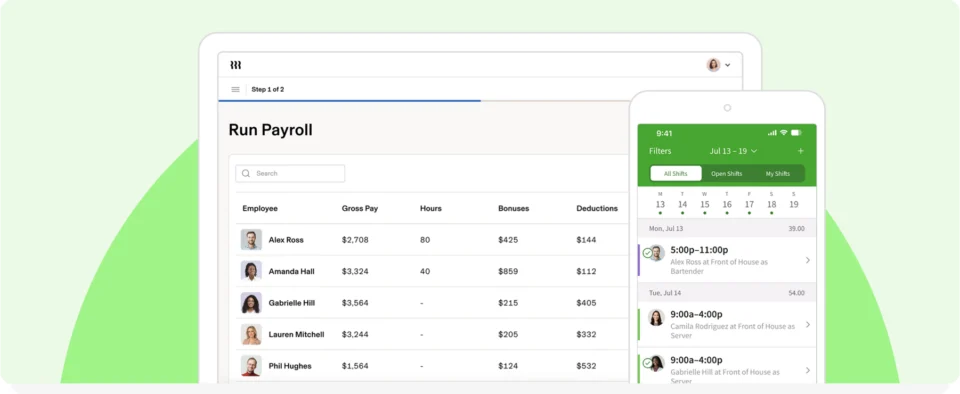
When I Work integrates seamlessly with payroll providers to save you even more time. Our payroll integrations, especially the one to our preferred partner, Rippling, help you connect scheduling and payroll in one streamlined workflow, so you can focus on running your business, instead of reconciling timesheets.
Start a free trial of When I Work today!
Payroll software vs payroll services FAQs
Q: Is payroll software cheaper than a payroll service?
A: Yes, payroll software is much more budget-friendly. Payroll services charge fees to manage everything on your behalf. Payroll software costs significantly less because you still manage your own payroll, but it automates calculations for you and scales easily as your business grows.
Q: Can a small business use a payroll service?
A: Yes, any business can use a payroll service, but they are generally built for larger companies with larger budgets.
Q: What’s the difference between a PEO vs payroll software?
A: A PEO acts as a co-employer, taking complete control of admin tasks and payroll from start to finish. Payroll software is an in-house, cloud-based tool that you manage yourself and customize to your business needs.
Q: Is payroll software safe?
A: Yes. Payroll software is highly secure. It’s computer and cloud-based, so it uses encryption and strict access controls to keep data safe. Keeping your payroll in-house with software actually reduces the risks of third-party data breaches compared to using an external service.
Q: Do I need payroll software if I only have a few employees?
A: Yes. Payroll software handles tedious calculations, including tax filings, that could easily result in errors if you try to do it yourself. Payroll software keeps your business compliant and protects you against legal payroll issues.
Q: Can I switch from a payroll service to a payroll software?
A: Absolutely! Moving to a payroll software lets you regain control of your data and lets you customize your reporting. You’ll minimize third-party security issues, and you can even save a significant amount of money.