People Management
Small Business Human Resources Guide

Key takeaways
- Human resources covers the people side of your business, including hiring, onboarding, scheduling, employee records, workplace policies, performance, and compliance.
- Small business HR does not always require a dedicated HR department, but it does require clear systems and consistent documentation.
- Employee files, an employee handbook, and required workplace posters are three HR basics every small business should understand.
- Strong HR practices help reduce confusion around schedules, time off, attendance, payroll, expectations, and workplace conduct.
- The right tools can make everyday HR tasks easier by helping small businesses manage schedules, time tracking, team communication, and employee availability.
Human resources is one of the most important parts of running a small business because it affects almost every employee-related decision you make. Hiring, training, scheduling, time off, payroll records, workplace policies, and employee performance all fall under the HR umbrella in some way.
For many small business owners, HR can feel complicated because it combines people management, legal responsibilities, documentation, and day-to-day operations. You may not have a full HR team, but you still need clear processes that help employees understand what is expected and help your business stay organized.
This guide breaks down the basics of small business human resources, including employee files, handbooks, compliance considerations, common HR mistakes, and the systems that make human resources for business easier to manage.
Table of contents
- Small business human resource management basics
- Three small business HR basics to get right first
- Common human resources mistakes small businesses should avoid
- How technology can support small business HR
- When to consider human resources for small businesses
- Make everyday HR easier with When I Work
- Free guides, forms, and templates for small business HR
- Start managing employee schedules and HR tasks with less admin
- Human resources management FAQs
- Make small business HR easier to manage
- Article sources
Small business human resource management basics
Human resource management, often shortened to HRM, is the process of managing the people side of a business. It covers the systems, policies, documents, and everyday decisions that help employees do their jobs safely, fairly, and effectively.
In a small business, human resource management often includes:
- Hiring and onboarding new employees
- Creating and maintaining employee records
- Managing employee schedules and availability
- Tracking time, attendance, and time off
- Supporting payroll and benefits administration
- Creating workplace policies and employee handbooks
- Handling performance reviews, training, and employee development
- Managing employee communication
- Supporting workplace safety, wellness, and compliance
Small business HR carries a big responsibility because it shapes how people experience your workplace. It affects how employees are hired, trained, scheduled, supported, paid, and held accountable.
Some small businesses outsource parts of HR, such as payroll, benefits, legal support, or compliance advice. Others handle most HR tasks internally. Either way, every small business needs some level of human resource management. Without clear HR processes, small problems around scheduling, attendance, communication, documentation, or workplace expectations can quickly escalate into operational issues.
Three small business HR basics to get right first
Human resources can feel intimidating because it touches legal requirements, employee documentation, workplace policies, and people management. For small businesses, the best place to start is with the basics: clear employee records, a practical employee handbook, and required workplace notices.
These three HR foundations will not cover every situation, and they are not a substitute for legal advice. However, they can help small business owners create better structure, reduce confusion, and avoid common documentation problems.
Employee files
Every small business should have a clear system for storing employee records. These files help you keep important information organized, support payroll and compliance, and document key employment decisions.
In many U.S. businesses, employee records are usually separated into different file types:
- I-9 file: Form I-9 is used to verify that employees are eligible to work in the United States. Many businesses keep I-9 forms together in a separate file rather than storing them inside each employee’s general personnel file.
- General employee file: This file usually includes employment documents such as resumes, offer letters, tax forms, payroll details, performance reviews, disciplinary records, training records, and other job-related documentation.
- Employee medical file: This file should be kept separate from the general employee file because it may include private medical information, disability-related documentation, doctor’s notes, or accommodation records.
Employee files should be accurate, secure, and easy to update. If you store employee records digitally, use secure systems with appropriate access controls. If you store paper records, keep them in a locked and protected location. Either way, only authorized people should be able to access sensitive employee information.
Employee handbook
An employee handbook gives employees a clear reference point for how your business operates. It explains expectations, policies, procedures, and workplace standards in one place, reducing misunderstandings and helping managers handle issues more consistently.
A small business employee handbook may include policies on:
- Anti-discrimination and equal employment opportunity
- Workplace safety and security
- Compensation, benefits, and payroll procedures
- Work schedules, availability, time off, and leave
- Attendance, lateness, no-shows, and absence reporting
- Standards of conduct, dress code, and workplace behavior
- Use of company equipment, devices, systems, and online accounts
- Performance reviews, promotions, discipline, and termination
- Employee records, confidentiality, and data handling
For shift-based businesses, the handbook should also explain how employees receive their schedules, how they request time off, how shift swaps are handled, and what happens if someone misses a shift or forgets to clock in.
Once the handbook is complete, make sure employees can easily access it. You may also want employees to sign an acknowledgment confirming that they received, read, and understood the handbook. Keep that acknowledgment in the employee’s file.
Related reading: How To Write An Employee Attendance Policy That’s Fair To Everyone
Required workplace posters
Depending on where your business operates, you may be required to display certain workplace posters or notices in a location where employees can easily see them. These notices often relate to employee rights, workplace safety, wage and hour laws, anti-discrimination rules, and other employment requirements.
Poster requirements can vary by country, state, city, industry, and business size. That means there is no single poster list that applies to every small business.
To stay on the right track, check requirements from official government sources or consult with qualified legal counsel. Some businesses also use poster compliance services that provide location-specific workplace notice packets.
The key is to treat required posters as part of your broader HR compliance process. They should be reviewed regularly, especially if your business opens a new location, hires in a new state, or changes its workplace policies.
Common human resources mistakes small businesses should avoid
Small business HR mistakes can become expensive quickly. A missing employee record, unclear job description, inconsistent attendance policy, or poorly documented performance issue may seem minor at first. Still, these problems can create confusion, compliance risk, and unnecessary admin work.
Here are some of the most common human resources mistakes to avoid.
Hiring too quickly
Small businesses often feel pressure to fill open roles fast, especially when every missing person affects the schedule. But hiring the wrong person can create bigger problems later, including missed shifts, poor performance, customer service issues, and higher turnover.
Before hiring, ensure the role is clearly defined, the schedule expectations are realistic, and the candidate understands the job requirements.
Using unclear job descriptions
A vague job description makes it harder to hire the right person and harder to manage performance later. Employees need to understand the role’s responsibilities, who they report to, the standards they are expected to meet, and how success will be measured.
Clear job descriptions also help managers make better scheduling, training, and performance decisions because everyone is working from the same set of expectations.
Skipping performance documentation
Performance conversations should be documented, especially when they involve attendance problems, repeated lateness, missed shifts, workplace conduct, or failure to meet job expectations.
Documentation doesn’t need to be complicated, but it should be consistent. Record what happened, when it happened, who was involved, what was discussed, and what are the next steps. Documentation gives managers a clearer record to refer back to if the same issue continues.
Ignoring employment laws
Every small business is responsible for following the employment laws that apply to its location, industry, and workforce. These may include rules around wages, overtime, worker classification, vacation and leave, anti-discrimination, workplace safety, recordkeeping, and employee rights.
Because employment laws can vary by state and local area, small businesses should use official government resources or qualified legal guidance when creating HR policies.
Misclassifying workers
Worker classification mistakes can create serious payroll, tax, and compliance problems. If your business uses contractors, part-time employees, seasonal workers, or temporary staff, ensure each worker is correctly classified and treated accordingly.
For example, a contractor should not usually be managed in the same way as an employee. If you control when, where, and how someone works, you may need to review whether the classification is correct.
Managing attendance without a clear process
Attendance issues are one of the most common HR challenges for shift-based businesses. If employees are late, miss shifts, forget to clock in, or request last-minute changes, managers need a consistent process for addressing these issues.
Your attendance policy should explain how employees report absences, how lateness is handled, what happens after a no-show, and how time-off requests should be submitted. The policy then helps employees understand the rules and helps managers respond fairly.
Related reading: Employee Attendance Policy [Save Time With Our Free Template]
Human resources mistakes are easier to avoid when your business has clear policies, accurate records, and reliable systems for managing schedules, time tracking, and team communication.
Try When I Work free to streamline employee scheduling, time tracking, and everyday HR tasks.

How technology can support small business HR
Technology has changed how small businesses manage human resources. Instead of relying only on paper files, spreadsheets, texts, and memory, employers can now use digital tools to manage schedules, time tracking, team messaging, time-off requests, payroll records, and HR documentation more consistently.
The goal of HR for small business is to reduce manual work, clarify employee expectations, and provide managers with better records when questions or issues arise.
Social media policies and employee conduct
Social media can create new HR challenges for small businesses, especially when employees post about work, customers, coworkers, or company accounts. A clear policy helps employees understand what is acceptable and enables managers to respond consistently when issues arise.
Your employee handbook should explain how employees are expected to handle work-related social media activity. It may include rules around using official company accounts, posting photos or videos from the workplace, discussing customers online, sharing confidential information, or representing the business publicly.
Employers should also be careful when using social media during hiring or disciplinary decisions. Public information may be visible, but that does not mean every online post should be used in an employment decision. Avoid asking candidates or employees for private login details, and consider getting legal guidance before taking action based on social media activity.
Technology overload and employee expectations
Technology can make work easier, but it can also blur the line between work time and personal time. Employees may feel pressured to respond to messages, schedule changes, or work updates outside their normal hours, especially when expectations are unclear.
Small businesses should set simple rules around communication. Employees should know where schedules are posted, how shift changes are shared, how urgent messages are handled, and whether they’re expected to respond outside scheduled work hours.
Clear guidelines are especially important for shift-based teams. If scheduling updates, time-off requests, and team messages are scattered across texts, calls, spreadsheets, and sticky notes, employees can miss important information. A more organized system helps keep communication clearer and reduces avoidable confusion.
Related reading: How To Deal With A Toxic Work Environment
HR data security
Small businesses are responsible for protecting employee information. HR records may include addresses, tax forms, payroll details, medical information, performance notes, disciplinary records, and other sensitive documents.
Whether your business uses paper files or digital records, employee data should be stored securely. Paper files should be kept in a locked location. Digital records should be protected with strong passwords, limited access, and secure systems.
Managers should also be careful about where employee information is shared. Payroll details, medical information, disciplinary notes, and private employee records should only be accessible to those who need them for legitimate business reasons.
Employee scheduling and time tracking tools
Scheduling and time tracking are two of the most common HR responsibilities for small businesses with hourly or shift-based employees. When these tasks are handled manually, mistakes create payroll issues, missed shifts, attendance confusion, and unnecessary manager admin.
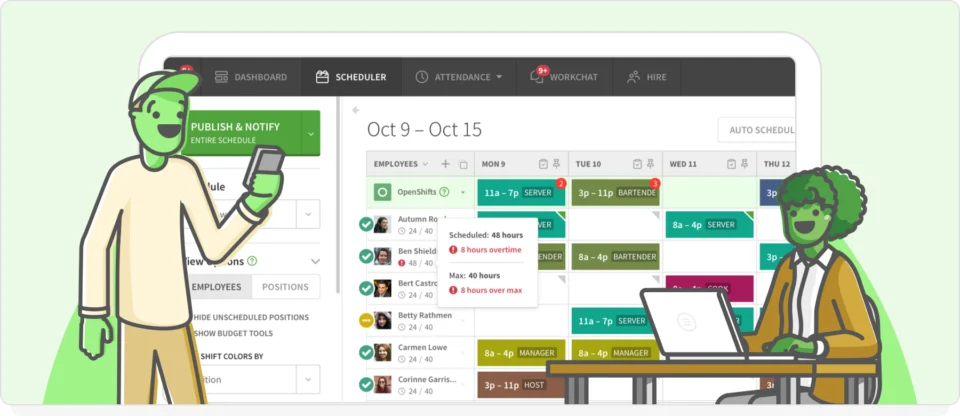
Employee scheduling software helps managers build schedules, share updates with the team, manage availability, and handle time-off requests in one place. Time-tracking tools also help employees clock in and out accurately, providing managers with better payroll and attendance records.
For small businesses, the right software makes everyday HR easier. Instead of chasing availability, correcting timesheets, and answering the same scheduling questions repeatedly, managers can use a single system to keep schedules, hours, and communication more organized.
Team communication tools
Clear communication is a major part of effective human resource management. Employees need to know when they are working, who they are working with, what has changed, and where to ask questions.
Team communication tools help small businesses keep work-related messages in one place. They’re useful for schedule updates, shift reminders, policy changes, team announcements, one-to-one messaging, and group communication.
For HR, better communication supports consistency. When employees receive the same information through the same system, there is less room for missed messages, informal side conversations, or confusion about expectations.
HR automation and reporting
The right tools also help small businesses reduce repetitive HR admin. For example, managers can automate schedule notifications, time-off workflows, shift reminders, absence tracking, or reporting.
Reporting is especially useful when reviewing attendance patterns, labor costs, schedule coverage, and employee availability. These records help managers spot recurring issues earlier and make better decisions.
For example, if the same shifts are hard to fill every week, or if certain employees regularly miss clock-ins, better reporting gives managers the information they need to act before the problem grows.
HR resources and support
Even with the right tools, small businesses may still need outside guidance for HR, legal, payroll, tax, or compliance questions. Employment requirements can vary by location, industry, and workforce size, so it is important to use reliable resources when creating or updating policies.
Helpful resources include:
- Official federal, state, and local government websites for employment law and workplace requirements
- The U.S. Department of Labor for wage, hour, leave, and workplace guidance
- The IRS for worker classification and tax-related employment information
- OSHA for workplace safety requirements
- SHRM and other HR organizations for general HR education and best practices
- Qualified legal, payroll, or HR professionals for business-specific advice
Getting your small business HR systems in place early can make employee management easier as your business becomes busier. Clear policies, secure records, accurate schedules, reliable time tracking, and better communication all help reduce confusion and give managers more control over day-to-day operations.

When to consider human resources services for small businesses
Some small businesses can manage everyday HR tasks internally with clear policies, reliable scheduling tools, accurate time tracking, and organized employee records. Others may need outside support for more complex issues.
Human resources services for small businesses can be useful when you need help with compliance, payroll, benefits, hiring processes, employee handbooks, workplace investigations, or state-specific employment requirements. These services can work alongside your internal systems, providing expert support when legal, payroll, or HR guidance is needed.
Make everyday HR easier with When I Work
Small business HR is easier to manage when employee schedules, time tracking, availability, time off, and team communication are organized in one place. When I Work helps small businesses reduce manual admin and keep day-to-day employee management running more smoothly.
With the When I Work app, managers can build employee schedules, share updates with the team, track hours, manage availability, review time-off requests, and communicate with employees without relying on scattered texts, spreadsheets, or paper notes.
For small businesses, When I Work can support key HR tasks such as:
- Creating and updating employee schedules
- Managing employee availability and time-off requests
- Tracking clock-ins, attendance, and hours worked
- Supporting payroll with more accurate timesheets
- Sending schedule updates and team announcements
- Using one-to-one messaging and group messaging to keep employees informed
- Reducing confusion around shift changes, missed shifts, and last-minute coverage
When I Work is not a replacement for legal, payroll, or HR compliance advice. But it can make the everyday operational side of HR much easier, especially for businesses with hourly, shift-based, part-time, seasonal, or multi-location teams.
Start your 14-day free trial of When I Work today.
Free guides, forms, and templates for small business HR
Small business owners don’t have to build every HR document from scratch. Templates are a useful starting point for common employee management tasks, including hiring, onboarding, job descriptions, employee policies, performance conversations, and termination documentation.
When I Work offers a free collection of HR resources for small business owners, including guides, forms, and templates that help you create clearer processes and save time on routine admin.
These resources help with:
- Hiring and onboarding new employees
- Creating job descriptions
- Writing employee policies
- Building employee forms and letters
- Managing performance documentation
- Handling employee communication more consistently
Use these templates as a starting point, then adapt them to your business, location, industry, and legal requirements. For compliance-sensitive documents, consider getting legal or HR guidance before using them with employees.
Get your free HR documents now.
Start managing employee schedules and HR tasks with less admin
Clear HR processes help employees understand what is expected of them. The right tools help managers apply those processes consistently.
When I Work helps small businesses manage employee scheduling, time tracking, availability, time off, and team communication in one app, so managers can spend less time chasing updates and more time running the business.
Start your 14-day free trial of When I Work today.
Human resources management FAQs
Human resources can feel complicated for small business owners, especially when you’re managing hiring, employee records, schedules, payroll, compliance, and workplace communication at the same time. These FAQs answer common questions about small business HR and the systems that make employee management easier.
Why is human resource management important for small businesses?
Human resource management is important for small businesses because it helps create structure around hiring, onboarding, scheduling, employee records, workplace policies, performance, payroll support, and compliance.
Good HR practices help employees understand what is expected and give managers a clearer process for handling common workplace issues. They can reduce confusion, improve communication, and help the business manage employee-related decisions more consistently.
What are the key responsibilities of human resources in small businesses?
Human resources in a small business can include hiring, onboarding, employee training, employee records, scheduling, time tracking, payroll support, benefits administration, performance management, workplace policies, employee relations, and compliance.
In many small businesses, these responsibilities are handled by the owner, a general manager, an office manager, or a small leadership team rather than a dedicated HR department. The important thing is to have clear processes, accurate records, and consistent communication.
What HR systems do small businesses need?
Small businesses benefit from HR systems that help manage essential employee tasks accurately and consistently. These may include systems for employee scheduling, time tracking, payroll, employee records, time-off requests, team communication, and compliance documentation.
For shift-based businesses, employee scheduling and time tracking are especially important because they affect coverage, attendance, labor costs, payroll accuracy, and day-to-day communication.
How can small businesses attract and retain employees through better HR practices?
Small businesses can attract and retain employees by creating a workplace where expectations are clear, schedules are fair, communication is consistent, and employees feel supported.
That may include offering competitive pay and benefits, giving employees clear job responsibilities, providing training, recognizing good work, managing schedules fairly, and making it easy for employees to request time off or update their availability.
What legal considerations should small businesses be aware of in HR management?
Small businesses should be aware of employment laws and regulations that apply to their location, industry, and workforce. These may include rules around minimum wage, overtime, worker classification, anti-discrimination, leave, workplace safety, employee rights, tax documentation, and recordkeeping.
Because legal requirements can vary by state and local area, small businesses should use official government resources or consult with qualified legal, payroll, or HR professionals when creating policies or handling compliance-sensitive situations.
How can small businesses create a more inclusive workplace through HR?
Small businesses can create a more inclusive workplace by adopting fair hiring practices, setting clear conduct policies, training managers, creating equal development opportunities, and ensuring employees are treated consistently.
Inclusion should also be visible in everyday operations. That means communicating policies clearly, handling concerns fairly, making schedules as transparent as possible, and building a workplace culture where employees understand what is expected and feel respected.
How does employee scheduling affect small business HR?
Employee scheduling affects small business HR by influencing attendance, labor costs, employee satisfaction, time-off requests, shift coverage, and payroll accuracy.
When schedules are unclear or constantly changing, employees are more likely to miss shifts, arrive late, or feel frustrated. A clear scheduling process helps managers keep the business covered while giving employees better visibility into their work schedules.
Can small businesses manage HR without a dedicated HR team?
Yes, many small businesses manage HR without a dedicated HR team. In these businesses, HR tasks are often handled by owners, managers, or administrators.
The key is to avoid relying on memory, scattered messages, or informal processes. Even without a dedicated HR department, small businesses should have clear employee records, written policies, consistent scheduling processes, accurate time tracking, and reliable communication systems.
Make small business HR easier to manage
Small business HR works best when employees know what is expected, managers have accurate records, and everyday tasks are easy to manage. That starts with clear policies, but it also depends on the systems you use to run the workday.
When I Work helps small businesses manage employee scheduling, time tracking, availability, time-off requests, and team communication in one app. Instead of chasing schedule changes, correcting timesheets, or relying on scattered messages, managers can keep the key moving parts of employee management in one place.
Start your 14-day free trial of When I Work today.
Article sources
1. U.S. Citizenship and Immigration Services. Form I-9, Employment Eligibility Verification. March 6th, 2026
2. U.S. Department of Labor. Fact Sheet 13: Employee or Independent Contractor Classification Under the Fair Labor Standards Act (FLSA). March 1st, 2026
3. Internal Revenue Service. Independent contractor (self-employed) or employee? May 19th, 2026
4. U.S. Equal Employment Opportunity Commission. EEOC Guidance. Accessed June 16th, 2026
5. Occupational Safety and Health Administration. Help for Employers. Accessed June 16th, 2026
6. U.S. Department of Labor. Summary of the Major Laws of the Department of Labor. Accessed June 16th, 2026
7. SHRM. Policies. Accessed June 16th, 2026